My Cat Sort:Pet Puzzle
- 5.0
- Rating
- 10.00K
- Installs
- Free
- Price

 Analysis by App-foxy
I picked up My Cat Sort: Pet Puzzle expecting a light trivia-style game with a cute theme, but its real appeal is the way it asks me to think before making a move. The central idea is simple: caring for adorable cats becomes a small logic and strategy challenge. That combination makes it easy to hand to someone else for a quick turn, while still giving me enough to consider when I want a quieter puzzle session.
That shared-device quality is important. I can imagine leaving it on a tablet in the living room and letting different people try a level when they have a spare moment. It does not demand a long appointment or a complicated explanation before someone can begin. At the same time, I would not treat it as a fully organized family game with built-in player management. The practical experience depends on how the household handles turns, progress, and purchases outside the game itself.
How the cat puzzle works in everyday play
The strongest part of the experience is the contrast between presentation and decision-making. The cats make the game feel friendly rather than intimidating, but the underlying challenge still rewards planning. I found myself looking beyond the immediately attractive move and considering what that move would leave behind. That is where the strategy comes from: a choice that looks helpful now can make the next arrangement awkward.
You May Also Like

 Pandora - Music & Podcasts
Pandora’s Music Is Easy to Start, but Harder to Recover
Pandora’s strength is its low-effort path from a seed to a station. Its weak spot is how much confidence it asks you to place in connection, setup, and quiet recovery.

 AccuWeather: Weather Radar
AccuWeather Review: A Quick, Clear Forecast for Everyday Decisions
For everyday plans, the best forecast is the one you can understand quickly. AccuWeather makes rain timing, radar, and local conditions easy to act on, with a few trade-offs.

 Hill Climb Racing
Why Hill Climb Racing Still Turns Crashes Into One More Run
A tiny car, a bumpy hill and one more upgrade: Hill Climb Racing keeps resurfacing because its simple chaos makes every near-miss feel personal.

 AliExpress - Shopping App
AliExpress Makes Global Shopping Feel Personal, but Shoppers Bear the Risk
AliExpress turns a global marketplace into a pocket-sized discovery engine. Its reach is useful, its shopping loop compelling, and its trade-offs easy to miss.

 Lords Mobile: Kingdom Wars
Lords Mobile Is a Kingdom-Building Routine, Not a Quick Match
A case-by-case verdict on the building, battles, device demands, and social commitments that make Lords Mobile rewarding for some players and exhausting for others.

 PDF Scanner app - TapScanner
TapScanner Makes Paperwork Easier to Capture, Check, and Share
TapScanner makes scanning with a phone feel less like a rescue operation and more like a dependable step in getting work done. Its capture tools are useful, though not flawless.
More From Our News Desk
View All News


For a short session, this works well. Someone waiting for dinner, taking a break from work, or sitting beside a family member can pick it up without committing to a large adventure. I especially like this format for households where one person enjoys traditional puzzles and another prefers something more playful. The cat theme softens the presentation without removing the need to reason.
A useful habit is to pause before acting and scan the whole arrangement rather than focusing on the most obvious cat. I also try to identify which move preserves the largest number of future options. That approach is more reliable than simply choosing the move that appears to improve one small area. It is a modest tip, but it changes the feel of the game from tapping through possibilities to making deliberate choices.
Another practical technique is to treat early moves as preparation rather than progress. If I use a move only because it produces an immediate visual improvement, I can sometimes create a tighter situation later. When I instead use the opening moments to create room and keep alternatives available, the puzzle feels more manageable. This is the kind of lesson that does not appear in a short store description but becomes clear after playing attentively.
A good fit for passing the device around
My Cat Sort: Pet Puzzle suits a shared screen because the basic premise is understandable at a glance. A parent can show a child what is happening, an older sibling can demonstrate a cautious approach, and another person can take over without needing a lengthy tutorial. For a household with mixed gaming habits, that low barrier matters more than a large feature list.
I would use it in a simple turn-taking routine: one person plays until reaching a natural stopping point, then hands over the device. Because the game is based on individual decisions rather than conversation-heavy competition, the room does not need to become noisy or organized around a formal match. That makes it a comfortable choice for a shared tablet in a kitchen or lounge.
There is a trade-off, though. A shared device is not the same as a shared account system. I would not assume that separate household members automatically receive separate progress spaces. Before making it a regular family activity, I would agree on whether the device belongs to one player, whether everyone follows the same run, or whether each person gets a clearly marked turn. That small conversation prevents confusion later.
The same point applies to achievements and personal goals. If one player is trying to solve carefully while another taps quickly, the resulting progress may no longer reflect either person’s preferred style. For casual use, that is harmless. For a household that cares about individual records, a different game with explicit profiles or multiplayer support would be a better choice.
What I would check before sharing it
Setup is straightforward in the sense that the game is free to download and is rated for Everyone. It runs on devices using Android seven or later, which covers many older phones and tablets. I still recommend checking the actual device before planning a shared installation, especially if the household keeps an older tablet for children or guests.
The more important boundary is spending. Optional in-app items range from ninety-nine cents to ninety-nine dollars and ninety-nine cents per item. That is a wide range, so I would not leave purchase decisions vague on a shared device. A child may see the game as a harmless cat puzzle, while an adult may not realize that an item can cost considerably more than a small impulse purchase.
My preferred household arrangement would be simple: the owner handles any purchase, other players ask first, and nobody treats a displayed offer as part of the normal cost of playing. Since the game itself is free, the family can enjoy the basic experience without turning every session into a shopping decision. That separation keeps the game relaxing and makes expectations clear.
I would also avoid presenting the game as a reward that depends on spending. The strategic enjoyment comes from solving the arrangement, not from assuming that an optional item is necessary for every difficulty. If a player feels pressured to buy something to continue enjoying the game, that is a useful sign to stop and reassess whether this is the right shared activity.
Coordinating turns without built-in assumptions
For a household, coordination works best when it is informal but explicit. I would choose one device, one agreed order, and a natural handoff point. That might be after a completed puzzle or after a short sitting, depending on the age and patience of the players. The important thing is not to imply that the game itself will manage the household’s schedule or identities.
This arrangement also helps when adults and children play together. An adult can explain why a move is risky without taking over the entire puzzle. Instead of solving everything, I would ask the younger player which spaces might become blocked and let them test the idea. The game’s logic gives the conversation a useful focus, turning a quick session into a small exercise in planning.
For siblings, I would be more careful about competitive language. If one child gets farther, that does not necessarily mean they understand the puzzle better; they may simply have made different early choices or had more uninterrupted time. Treating each turn as a shared problem rather than a ranking contest makes the experience more welcoming.
There is also a practical reason to coordinate around interruptions. Puzzle games are less enjoyable when someone takes over halfway through a thought. If the device is needed for schoolwork, a call, or another household task, finish a sensible point before handing it over when possible. That preserves the reasoning process and avoids blaming the game for a rushed decision.
Age context and trust
The Everyone rating and the gentle cat presentation make this an approachable option for a broad age range. I would feel comfortable introducing the concept to a child who enjoys sorting, matching, or logic activities, provided an adult has already explained the household’s rules for device use and purchases. The rating describes the intended age context, but it does not replace supervision or family judgment.
For younger players, the best use is probably collaborative. An adult can help with reading any on-screen wording and focus attention on the consequences of a move. For older children and adults, the game can stand on its own as a short strategy break. I would not oversell it as an educational tool, but it naturally encourages patience, prediction, and learning from a poor choice.
Trust matters more than the cute theme. I would show children which actions are ordinary gameplay and which may involve an optional purchase, then make it clear that asking first is part of using the shared device. That is a healthier arrangement than assuming a child will understand every prompt simply because the game looks harmless.
Adults who dislike games that rely on visual charm may find the presentation too gentle, especially if they want dense trivia, word questions, or factual knowledge tests. Although it sits in the trivia category, my experience is closer to a visual logic exercise than a conventional quiz. Someone looking for general-knowledge rounds or competitive question answering should choose a traditional trivia app instead.
Where it differs from usual trivia and puzzle alternatives
Compared with a standard trivia game, this title asks me to reason through an arrangement rather than recall information under time pressure. That makes it better for players who enjoy planning but do not want to be judged on facts they already know. It is also more suitable for quiet shared play, because people can discuss possible moves instead of racing to answer first.
Compared with a large puzzle adventure, it feels more focused. I do not approach it expecting a story, character development, or a broad world to explore. The benefit is accessibility: I can open it for a compact challenge without remembering a complicated plot. The limitation is that players seeking a deep campaign may find the cat-sorting premise narrower than a full puzzle game.
Compared with a purely casual matching game, it gives my choices more weight. I cannot rely only on quick reactions or attractive combinations; I need to think about the next position. That makes it more satisfying for deliberate players, but perhaps less suitable for someone who wants completely mindless tapping after a tiring day.
The developer is ziyaokeji, and the current release is version 1.0.6. The game has attracted over ten thousand installs and holds a five-point average from around one hundred fifty ratings, with a small number of written reviews. Those figures suggest a positive early response, but I would interpret them as a snapshot rather than proof that every household will enjoy the same style of play.
Because the audience is still relatively compact, I would judge it mainly by whether the core puzzle suits the player rather than by popularity alone. A high average can be encouraging, but a person who wants multiplayer competition, detailed profiles, or a long narrative should still look elsewhere. The right question is whether a calm cat-themed logic challenge fits the way the device will actually be used.
Small strategies that improve a shared session
My first recommendation is to let the least experienced player choose the opening move while the others explain their thinking without issuing commands. This keeps the session cooperative and teaches the structure of the puzzle. If the group always lets the strongest player act, everyone else becomes an observer and the shared-device advantage disappears.
My second recommendation is to announce a “thinking pause” before a risky move. That sounds minor, but it prevents a child or guest from feeling rushed by someone waiting to take the device. It also helps the group notice that the game rewards planning rather than speed. A pause can turn a mistake into a useful discussion instead of an argument over whose turn it was.
A third useful approach is to keep purchases outside the turn system. If someone wants an optional item, that should be an adult decision made separately from the puzzle session. Mixing buying requests with gameplay makes it harder for children to understand what they are being asked to choose and can make a free game feel commercially demanding.
Finally, I would stop a session when the group becomes more interested in controlling one another than solving the puzzle. This is not a flaw unique to the game; it is a sign that the shared arrangement needs a break. My Cat Sort: Pet Puzzle works best when the device remains a tool for a small, friendly challenge rather than becoming a source of household competition.
Who should install it, and who should skip it
I would recommend it to someone who likes cute presentation, visual organization, and puzzles that reward foresight. It is particularly appealing for a parent and child who want a calm activity on one screen, roommates looking for a short break, or a solo player who enjoys testing different approaches without entering a large game world.
I would be less likely to recommend it to a player who wants a conventional quiz with factual questions, a competitive online leaderboard, or clearly separated household profiles. I would also skip it for a family that cannot agree on purchase boundaries, because the free entry point does not remove the need for responsible spending decisions.
Players with very limited storage or older hardware should check compatibility before relying on it for a trip or shared activity. The minimum Android requirement is seven or later, and iOS availability makes it relevant to Apple users as well, but the smoothness of any game can still depend on the particular device and its condition.
The age rating makes it easy to consider for general family use, yet I would still introduce it with context: this is a strategy puzzle dressed in a friendly cat world, not an educational quiz or a social game with guaranteed separate identities. That honest explanation helps each person decide whether the style matches what they want.
My household verdict
After spending time with it, I see My Cat Sort: Pet Puzzle as a pleasant shared-device game with a more thoughtful core than its soft presentation first suggests. Its best quality is the balance between immediate approachability and the need to plan ahead. I can recommend it for short solo sessions, cooperative turns, and relaxed family conversations about choices.
My reservations are equally practical. The shared-device experience needs household rules because I would not assume that every player has an independent space. The optional purchase range deserves adult attention, and the game will not satisfy people who came for fact-based trivia or a large multiplayer system. Those are not reasons to reject it; they are reasons to install it with the right expectations.
For a free game from ziyaokeji, it offers a focused way to make a spare few minutes feel more engaging. I would put it on a common tablet when the goal is a gentle puzzle that several people can understand and discuss, while keeping account and spending decisions with the device owner. My recommendation is positive for calm, cat-themed logic play, but selective for households that need formal profiles, competitive features, or strict separation between players.
FAQs for My Cat Sort:Pet Puzzle
01What is My Cat Sort: Pet Puzzle, and how is the gameplay structured?
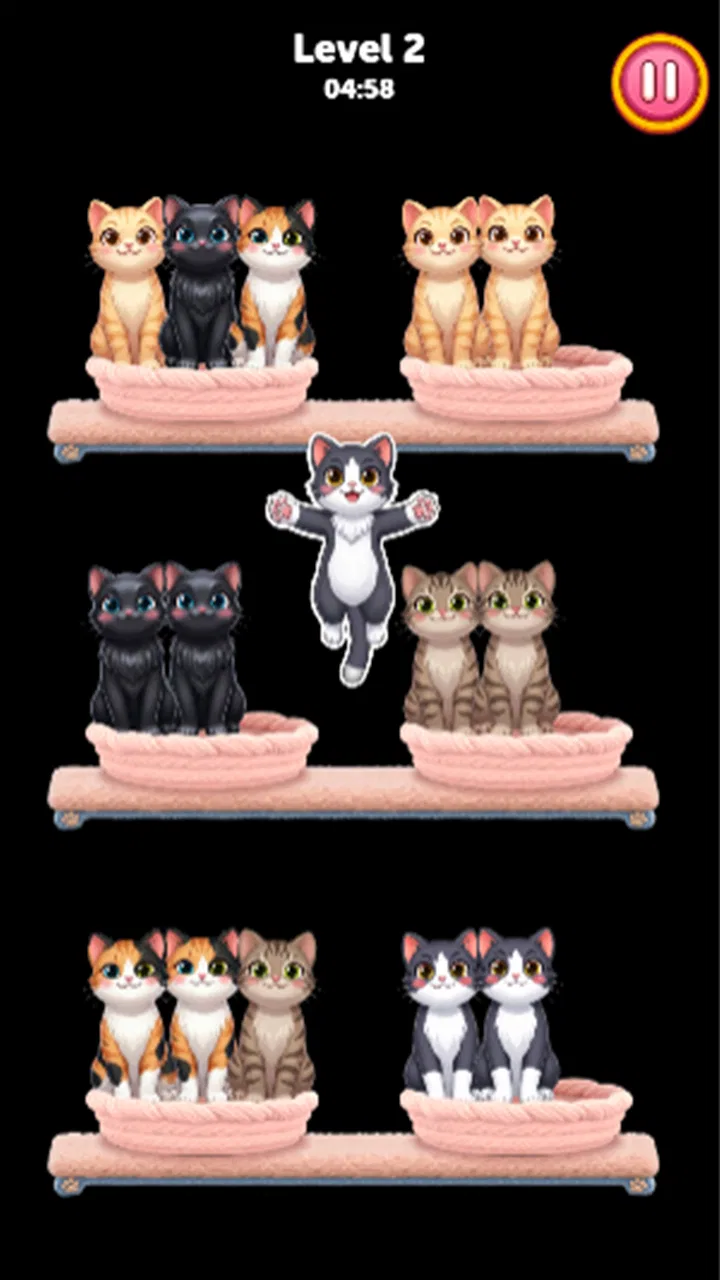
My Cat Sort: Pet Puzzle is a casual sorting game built around arranging adorable cat characters and matching them according to their colors, types, or designated spaces. Each level typically presents a board with limited room, so you need to plan your moves carefully rather than sorting randomly. The early stages are simple and relaxing, while later puzzles introduce more crowded layouts and require better forward planning.
02Is My Cat Sort: Pet Puzzle free to download and play?
The game can generally be downloaded for free, allowing players to try its core puzzles without paying upfront. However, free-to-play games commonly include optional advertisements, extra rewards, or in-app purchases for items such as hints, coins, lives, or other conveniences. Before downloading, check the current Google Play or App Store listing for the latest information about advertising, purchases, and any platform-specific restrictions.
03Does My Cat Sort: Pet Puzzle require an internet connection?
Many of the basic sorting levels may be playable without a constant internet connection, which makes the game suitable for short sessions while traveling or when mobile data is unavailable. Nevertheless, online access may be needed for advertisements, cloud features, special events, updates, or purchases. Offline behavior can also vary after updates, so it is best to test the game once before relying on it without Wi-Fi or mobile data.
04Is My Cat Sort: Pet Puzzle suitable for children and casual players?
The game is designed to be easy to understand, with simple touch controls and colorful cat-themed visuals that can appeal to both children and adults. It does not usually require fast reactions, making it approachable for casual players who prefer relaxed puzzle sessions. Parents should still review the store’s age rating and manage in-app purchases or advertising settings, since the available content and monetization options may change.
05What should I know about hints, difficult levels, and progress in the game?
As the puzzles become more complex, a single misplaced cat can limit your available moves and force you to restart or use a hint. Taking a moment to identify the correct order is usually more effective than tapping quickly. Hints or extra moves may be limited and could be connected to ads or in-game currency. Also, verify whether progress is backed up through the platform or an account before changing devices or reinstalling the app.
Pros
- Simple sorting mechanics are easy to learn within a few seconds.
- Cute cat animations make routine puzzle moves feel more rewarding.
- Short levels fit well into quick breaks or casual play sessions.
- Increasing difficulty keeps the basic gameplay from becoming repetitive.
- Offline play is convenient when you have no internet connection.
Cons
- Later puzzles can feel repetitive if you prefer more varied gameplay.
- Some stages may require trial and error rather than pure planning.
- Optional rewards and bonuses can encourage frequent ad viewing.
- The game offers limited interaction beyond sorting and completing levels.
- Progress may feel slow for players looking for fast unlocks.

My Cat Sort:Pet Puzzle
Gallery